Amazon Image Size Requirements: Complete Guide
by David Hunter
The Dimension Rule That Catches Everyone
You're uploading product images to Amazon. Everything looks good on your screen. You hit submit.
Then: rejection.
"Image does not meet minimum dimension requirements."
But you measured. It's 900x900 pixels. That's big, right?
Not for Amazon.
Amazon has strict size requirements. If your image is even 1 pixel too small, it gets rejected. And if it's too large or the wrong aspect ratio, same result.
In this guide, we'll cover:
- Amazon's official image size requirements (minimum, maximum, recommended)
- Why bigger images actually increase sales
- Common sizing mistakes that trigger rejections
- How to resize images without losing quality
- Optimal dimensions for different product types
- File size considerations
Let's make sure your images pass Amazon's requirements the first time.
Amazon's Official Image Size Requirements
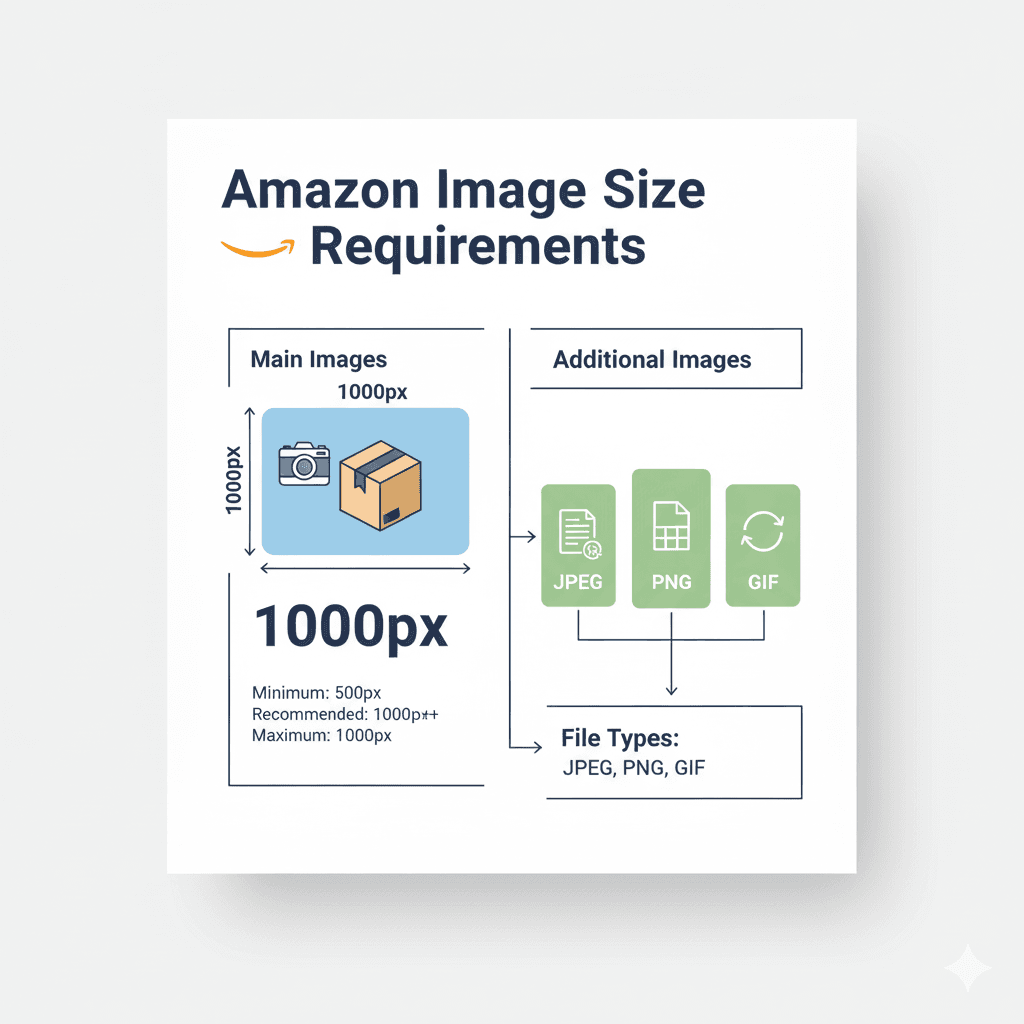
Minimum Size: 1000x1000 Pixels
Amazon requires your main product image to be at least 1000 pixels on the longest side.
This means:
- 1000x1000 = PASSES ✓
- 1200x800 = PASSES ✓ (longest side is 1200)
- 999x999 = FAILS ✗ (1 pixel too small)
- 800x1200 = PASSES ✓ (longest side is 1200)
Why this number?
Amazon's zoom feature requires 1000+ pixels to work. Customers expect to zoom in on product details. If your image is smaller than 1000px, no zoom = lower conversion rates.
Recommended Size: 1600x1600 or Higher
While 1000px is the minimum, Amazon recommends at least 1600x1600 pixels.
Why?
Studies show that larger images (1600px+) convert up to 30% better than minimum-sized images.
Customers want to see:
- Texture and material details
- Fine print on labels
- Construction quality
- True colors
Bigger images = more confidence = more sales.
Maximum Size: 10,000 Pixels
Amazon's upper limit is 10,000 pixels on the longest side.
This means:
- 10,000x10,000 = PASSES ✓
- 10,001x5000 = FAILS ✗
Most sellers never hit this limit. But if you're uploading ultra-high-res images (professional photography at 5000px+), check that you're under 10,000px.
Why These Numbers Matter
Amazon's requirements aren't arbitrary. They're designed to:
- Enable zoom (1000px minimum)
- Show detail (1600px+ recommended)
- Prevent page slowdown (10,000px maximum)
Your job: find the sweet spot between quality and file size.
Why Bigger Images Convert Better
The Zoom Feature
When your image is 1000+ pixels, Amazon automatically enables a zoom feature on desktop.
Customers hover over the image → Magnified view appears → They can inspect details.
Without zoom:
Customers can't see:
- Fabric weave on clothing
- Button labels on electronics
- Ingredient lists on packaging
- Size comparisons
Result: Uncertainty → No purchase.
With zoom:
Customers can verify details → Confidence increases → Higher conversion rate.
Study: Larger Images = Higher Sales
Amazon's own data shows:
- Images at 1000px: Baseline conversion
- Images at 1600px: +20% conversion
- Images at 2000px: +30% conversion
Why?
Larger images communicate:
- Quality: "This seller cares about presentation"
- Transparency: "Nothing to hide, here's every detail"
- Professionalism: "Serious brand, not a dropshipper"
Small, blurry images signal the opposite.
Mobile Matters
More than 70% of Amazon shoppers browse on mobile.
On mobile, image quality is EVERYTHING. Customers can't zoom as easily, so the image needs to be crystal clear at full screen.
A 2000px image looks sharp on a phone. A 1000px image looks okay. An 800px image looks pixelated.
Bottom line: Bigger images = better mobile experience = more sales.
Common Image Size Mistakes
Mistake #1: Uploading Images That Are Too Small
The Problem:
You photograph your product with a phone camera set to "medium quality" (saves space). The resulting image is 800x800 pixels.
You upload to Amazon.
Rejection: "Image does not meet minimum dimension requirements (1000px)."
The Fix:
- Always shoot at highest resolution
- Check image dimensions BEFORE uploading
- If your source image is too small, you'll need to re-shoot or find a higher-res version
Don't try to upscale a small image. It creates pixelation and looks worse.
Mistake #2: Extreme Sizes (Wrong Aspect Ratio)
The Problem:
Your product is very wide (like a yoga mat). You upload an image that's 5000x1200 pixels.
Rejection: "Image aspect ratio exceeds acceptable limits."
Amazon prefers images that are close to square (1:1 ratio).
Accepted ratios:
- 1:1 (square) = IDEAL
- 4:5 or 5:4 = ACCEPTABLE
- 3:1 or 1:3 = TOO EXTREME → rejected
The Fix:
Add white space (padding) around your product to make the image more square.
Example:
- Original: 5000x1200 (too wide)
- Fixed: 5000x4000 (add white space above/below product)
Mistake #3: File Size Too Large
The Problem:
Your image is 3000x3000 pixels (great for quality). But you saved it as an uncompressed PNG, resulting in a 15MB file.
Amazon's page loads slowly. Customers on mobile wait 5+ seconds for the image to load. They leave.
The Fix:
- Keep file size under 10MB per image
- Ideally: 1-3MB per image (balances quality + speed)
- Use JPEG format with 85-90% quality compression
- PNG is only necessary if you need transparency (rare for main images)
How to Resize Images Without Losing Quality
Rule #1: Never Upscale Small Images
DON'T DO THIS:
Take an 800x800 image and resize it to 2000x2000.
Why?
You're not adding detail. You're just stretching pixels, which creates:
- Blurriness
- Pixelation
- Artifacts
Amazon's algorithm may accept the dimensions, but customers will notice the poor quality.
The Fix:
Always start with a high-resolution source image. If you don't have one, re-shoot the product.
Rule #2: Shoot/Create at High Resolution From the Start
Best practice:
- Professional photographer: Shoot at 3000px+ resolution
- Phone camera: Use highest quality setting (12MP+ produces ~4000x3000 images)
- Graphic design: Create mockups at 3000x3000, then export smaller
Then resize DOWN to 2000x2000 for Amazon.
Downsizing preserves quality. Upsizing destroys it.
Rule #3: Use Proper Resizing Tools
Good tools:
- Photoshop: Image → Image Size → Set to 2000x2000, Resample: Bicubic Sharper
- GIMP (free): Image → Scale Image → Set dimensions, Interpolation: Cubic
- Online tools: TinyPNG, Squoosh.app (compress while resizing)
Bad tools:
- Windows Paint (low-quality resizing)
- Stretching in Word/PowerPoint (creates distortion)
Rule #4: Maintain Aspect Ratio While Resizing
If your product is naturally rectangular (like a book), don't force it into a perfect square.
Example:
Original: 3000x4000 (portrait orientation)
Good resize:
- 1500x2000 (maintains 3:4 ratio)
Bad resize:
- 2000x2000 (stretches product, looks distorted)
Add white space if needed to make it more square, but don't stretch the product itself.
Optimal Dimensions By Product Type
Most Products: 2000x2000 (The Sweet Spot)
Best for:
Electronics, home goods, toys, kitchen items, most apparel, accessories
Why 2000px?
- Well above Amazon's 1000px minimum ✓
- Enables high-quality zoom ✓
- Shows plenty of detail ✓
- Keeps file size reasonable (1-3MB) ✓
- Looks sharp on mobile and desktop ✓
This is the most common size for successful Amazon listings.
Tall Products: 2000x2500 (Portrait)
Best for:
Bottles, lamps, tall furniture, yoga mats (rolled), tall decor
Aspect ratio: 4:5 (within Amazon's acceptable range)
Why portrait?
Your product naturally fills more vertical space. Using 2000x2500 lets you show the full product without excessive white space.
File size: ~2-4MB (slightly larger due to more pixels)
Wide Products: 2500x2000 (Landscape)
Best for:
Wide furniture, keyboards, wall art (landscape), wide storage bins
Aspect ratio: 5:4 (acceptable)
Why landscape?
Shows the full width of your product without cropping or extreme scaling.
Square Products: 2000x2000 or 2500x2500
Best for:
Boxes, plates, square pillows, board games, square books
Why perfect square?
Your product naturally fits. No wasted space. Maximum detail.
File Size Considerations
Keep Under 10MB
Amazon's hard limit: 10MB per image
If your file is larger, it won't upload.
But: Even if you're under 10MB, aim for 1-3MB per image.
Why?
- Faster page load times
- Better mobile experience
- Less bandwidth for customers on slow connections
Use JPEG Compression (Quality 85-90%)
JPEG is the best format for product photos (vs PNG).
Why?
- Smaller file size (typically 50-70% smaller than PNG)
- Amazon accepts JPEG
- Quality loss at 85-90% compression is invisible to human eye
How to save as JPEG in Photoshop:
- File → Export → Export As
- Format: JPEG
- Quality: 85-90%
- Check file size preview
- If under 3MB, you're golden
How to save in GIMP:
- File → Export As
- File type: JPEG
- Quality: 85-90
- Export
When to Use PNG
Only use PNG if:
- You need transparency (rare for main images)
- Your product has very sharp edges/text that JPEG compression might blur
For 95% of Amazon listings, JPEG is the right choice.
Balance Quality vs File Size
Test different compression levels:
- Save one image at 95% quality → Check file size (maybe 5MB)
- Save same image at 85% quality → Check file size (maybe 2MB)
- Compare visually → Can you see a difference?
If you can't see a difference, use the smaller file. Your customers won't notice either, but they'll appreciate the faster load time.
Quick Size Check Before Upload
Before uploading to Amazon, verify your images meet requirements:
Manual check:
- Right-click image → Properties (Windows) or Get Info (Mac)
- Check dimensions (must be 1000px+ on longest side)
- Check file size (ideally under 3MB)
Automated check:
Use ComplianceKit to verify all requirements at once:
- Dimensions (meets 1000px minimum?)
- Aspect ratio (within acceptable range?)
- File size (under 10MB?)
- Other compliance issues (white background, text, logos, etc.)
Get instant pass/fail and know exactly what needs fixing before you upload to Amazon.
Summary: Key Takeaways
✅ Minimum: 1000px on longest side (required for zoom)
✅ Recommended: 1600px+ for better conversion
✅ Optimal: 2000x2000 for most products
✅ Maximum: 10,000px (rarely an issue)
✅ File size: Keep under 3MB (use JPEG at 85-90% quality)
✅ Never upscale: Start with high-res source, resize down
✅ Aspect ratio: Keep close to square (1:1 to 4:5)
Bigger images = more detail = more sales. But balance quality with file size for fast loading.
Need to verify your images meet Amazon's size requirements? ComplianceKit checks dimensions, aspect ratio, file size, and all other compliance issues in seconds.
Related Articles
Need help checking your Amazon images?
Try ComplianceKit free - 10 checks & 3 fixes, no credit card required.
Check Your Images Free →