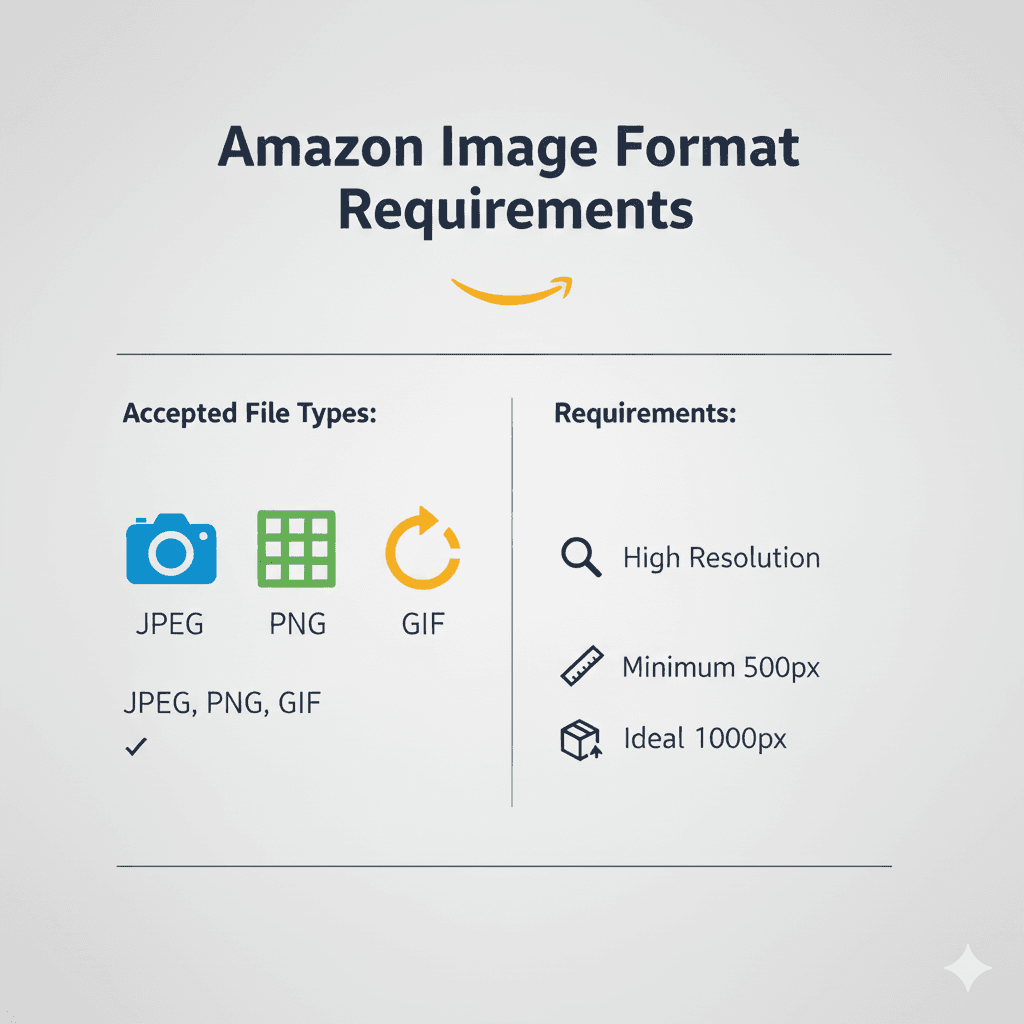
Amazon Image Format Requirements (JPEG, PNG, GIF)
by David Hunter
The Format Nobody Thinks About (Until Amazon Rejects It)
You've got a perfect product photo. White background, proper dimensions, product centered, high resolution.
You upload it to Amazon.
Rejection: "Image file format is not supported."
Or worse: Image uploads, listing goes live, but your main image loads slowly and looks pixelated on mobile.
The culprit? Wrong file format or inefficient compression.
Most sellers don't think about image file format. They assume if it's a picture, Amazon will accept it.
Not quite.
Amazon accepts four image formats: JPEG, PNG, GIF, and TIFF. But not all formats are created equal. Some work better than others. Some are too large. Some cause quality issues.
In this guide, I'll explain:
- Which formats Amazon accepts (and which it doesn't)
- Why JPEG is almost always the best choice
- When PNG makes sense (spoiler: rarely for Amazon)
- File size limits and why they matter
- Common format mistakes that cause rejections
- How to check and fix format issues before uploading
Let's make sure your images are in the right format so they upload smoothly and display perfectly.
Amazon's Accepted Image Formats
The Four Accepted Formats
Amazon officially accepts these image formats:
- JPEG (.jpg or .jpeg)
- PNG (.png)
- GIF (.gif)
- TIFF (.tif or .tiff)
If your image is in one of these formats, Amazon will accept it (assuming it meets other requirements like dimensions, background, etc.).
Formats Amazon Does NOT Accept
These formats will be rejected:
- BMP (.bmp) - Bitmap files
- WebP (.webp) - Google's web format
- HEIC (.heic) - iPhone's newer format
- RAW (.raw, .cr2, .nef, etc.) - Camera raw files
- PSD (.psd) - Photoshop files
- AI (.ai) - Adobe Illustrator files
- SVG (.svg) - Vector graphics
If you try to upload these formats, Amazon will reject them immediately with an error message.
Why Amazon Limits Formats
Amazon standardizes on a few formats to:
- Ensure compatibility across all devices
- Maintain consistent image quality
- Optimize page load speeds
- Simplify image processing in their system
JPEG, PNG, GIF, and TIFF are universally supported formats that work on every browser and device. That's why Amazon sticks with them.
JPEG: The Best Format for Most Product Images
Why JPEG Is Recommended
JPEG (Joint Photographic Experts Group) is the format you should use 99% of the time for Amazon product images.
Advantages of JPEG:
✅ Small file size - Compressed efficiently without visible quality loss
✅ Fast loading - Smaller files = faster page load times
✅ Universal support - Works everywhere
✅ High quality - Supports millions of colors
✅ Perfect for photos - Designed specifically for photographic images
✅ Amazon's preferred format - What most sellers use
JPEG uses "lossy compression," meaning it reduces file size by removing some data. But at high quality settings (85-95%), the compression is invisible to the human eye.
Result: Your 5MB PNG becomes a 500KB JPEG with no noticeable quality difference.
When to Use JPEG
Use JPEG for:
- Product photos on white backgrounds
- Lifestyle images
- Packaged products
- Any photographic image
- Main images and additional images
JPEG is ideal when:
- Your image is a photograph (not a graphic)
- File size matters (it always does for web)
- You need high quality at reasonable file sizes
Example:
You photograph your product with a DSLR camera. The image is 6000x4000 pixels and saves as a 12MB file.
Export as JPEG (quality 90%): File becomes 1.2MB with no visible quality loss.
Export as PNG: File stays 12MB or becomes 8MB with compression.
JPEG wins.
JPEG Quality Settings
When saving as JPEG, you'll see a quality slider (usually 0-100 or 0-12).
Recommended settings for Amazon:
- 85-95% quality = Perfect balance of quality and file size
- Below 80% quality = Visible compression artifacts (avoid)
- 95-100% quality = Unnecessarily large files with minimal quality gain
Sweet spot: 90% quality
At 90%, you get:
- High visual quality (indistinguishable from 100%)
- Reasonable file size (usually 500KB-2MB for 2000x2000 images)
- Fast page loading
- Happy customers
JPEG Disadvantages (Minor for Amazon)
JPEG is not ideal for:
- Graphics with sharp edges and text (but you're not using those on Amazon anyway)
- Images requiring transparency (Amazon doesn't allow transparent backgrounds)
- Images that will be edited multiple times (quality degrades with repeated saves)
For Amazon product photos, none of these disadvantages matter.
You're uploading final photos, not editing them repeatedly. You don't need transparency (white background required). Your images are photographs, not graphics.
JPEG is perfect for Amazon.
PNG: When Transparency Doesn't Help
What PNG Offers
PNG (Portable Network Graphics) is a lossless format, meaning no quality is lost during compression.
PNG advantages:
✅ Lossless compression - No quality degradation
✅ Supports transparency - Can have transparent backgrounds
✅ Good for graphics - Sharp edges and text render well
✅ No compression artifacts - Preserves every pixel exactly
Sounds great, right?
For Amazon, PNG's advantages don't matter.
Why PNG Isn't Ideal for Amazon
Problem #1: Amazon doesn't use transparency
PNG's biggest feature is transparency support. But Amazon requires:
- Main images: Pure white background (RGB 255, 255, 255)
- Additional images: Backgrounds allowed, but transparency isn't useful
If you upload a PNG with a transparent background, Amazon will reject it for not having a white background.
So PNG's main advantage is useless for Amazon.
Problem #2: Larger file sizes
PNG files are 3-10x larger than equivalent JPEG files.
Example:
Same 2000x2000 product image:
- JPEG (90% quality): 800KB
- PNG: 4.5MB
That PNG loads 5-6x slower than the JPEG with zero visible quality difference at Amazon's display sizes.
Problem #3: No benefit for photographs
PNG's lossless compression is great for graphics with sharp edges (logos, text, illustrations). But for photographs, human eyes can't distinguish PNG from high-quality JPEG.
You're paying a file size penalty for quality you can't see.
When PNG Makes Sense (Rarely)
Consider PNG only if:
- You're creating graphic overlays for additional images (infographics with text and sharp lines)
- You need to preserve every single pixel exactly (unusual for product photos)
- File size isn't a concern (it should be)
For standard product photos on white backgrounds, PNG offers no advantage over JPEG.
The Transparent Background Trap
Common mistake:
You remove the background in Photoshop and save as PNG with transparency, thinking Amazon will handle the white background.
What happens:
Amazon rejects it because the background isn't white—it's transparent.
The fix:
Add a white background layer before exporting, or save as JPEG (which doesn't support transparency, forcing you to have a background).
Better yet: Just use JPEG from the start and add a white background. Simpler and smaller file size.
GIF: Almost Never Use This
What GIF Is
GIF (Graphics Interchange Format) is an ancient format (1987) designed for simple graphics and animations.
GIF characteristics:
- Limited to 256 colors (terrible for photos)
- Supports transparency
- Supports animation (multiple frames)
- Very small file sizes
- Optimized for simple graphics, not photos
Why GIF Is Wrong for Product Images
Problem #1: Only 256 colors
Your product photo has millions of colors (subtle shadows, gradients, skin tones). GIF reduces this to 256 colors, causing:
- Banding (visible color steps instead of smooth gradients)
- Loss of detail
- Dull, flat-looking images
Problem #2: Poor quality
GIF was never designed for photographs. It looks terrible for product images.
Problem #3: No advantage
Even though GIF has small file sizes, JPEG achieves similar sizes with vastly better quality.
When GIF Makes Sense (Never for Amazon)
GIF is useful for:
- Simple logos with few colors
- Animated images (Amazon doesn't allow these on listings anyway)
- Extremely simple graphics
For Amazon product photos: Never use GIF.
Your images will look washed out, flat, and unprofessional.
Use JPEG instead.
TIFF: Too Large, Skip It
What TIFF Is
TIFF (Tagged Image File Format) is a high-quality, uncompressed (or lightly compressed) format used in professional photography and printing.
TIFF characteristics:
- Extremely high quality
- Lossless or uncompressed
- Supports multiple layers
- HUGE file sizes (10MB-50MB+ per image)
Why TIFF Is Wrong for Amazon
Amazon accepts TIFF, but you shouldn't use it.
Problem #1: Massive file sizes
A 2000x2000 TIFF file can be 20MB or more. That's 20x larger than an equivalent JPEG.
Problem #2: Slow loading
Uploading and downloading 20MB images is slow. Customers on mobile will wait forever for your images to load.
Problem #3: No benefit
TIFF's quality advantage only matters for printing large formats (posters, billboards). On a computer or phone screen, JPEG at 90% quality looks identical to TIFF.
You're making your images load slower for zero visual benefit.
When TIFF Makes Sense (Not for Amazon)
TIFF is useful for:
- Professional printing (magazines, posters)
- Archiving original photos (before editing)
- When file size doesn't matter and quality is critical
For Amazon listings: Never use TIFF.
Convert to JPEG before uploading. Your customers will thank you for faster loading times.
File Size Limits and Best Practices
Amazon's Maximum File Size
Amazon's limit: 10MB per image
If your file exceeds 10MB, Amazon will reject it.
But just because you CAN upload 10MB images doesn't mean you SHOULD.
Optimal File Sizes for Amazon
Recommended file sizes:
- Main image (2000x2000): 500KB - 1.5MB
- Additional images: 500KB - 2MB
- Infographics with text: 1MB - 3MB (PNG might be justified here)
Why smaller is better:
✅ Faster page loading - Customers see your images instantly
✅ Better mobile experience - Mobile users on slow connections can still load images
✅ Reduced bounce rate - Slow-loading pages cause customers to leave
✅ Better conversion - Fast-loading images = more sales
Amazon's own studies show: A 1-second delay in page load time reduces conversions by 7%.
Your 5MB PNG might be costing you sales.
How to Reduce File Size
If your images are too large:
Method 1: Save as JPEG instead of PNG
This alone usually cuts file size by 70-90%.
Method 2: Lower JPEG quality slightly
Change from 100% to 90% quality. File size drops 50%+ with no visible quality loss.
Method 3: Resize before saving
Amazon displays images at specific sizes. Don't upload 5000x5000 images when Amazon will resize them to 2000x2000 anyway.
Resize to 2000x2000 or 2500x2500 before saving.
Method 4: Use image optimization tools
Tools like TinyJPG, ImageOptim, or Photoshop's "Save for Web" compress images further without quality loss.
Example workflow:
- Edit photo in Photoshop
- Resize to 2000x2000
- Export as JPEG, quality 90%
- Run through TinyJPG (reduces file size another 30-50%)
- Final file: 600KB, perfect quality
Color Mode: RGB vs CMYK
Why This Matters
Images can be saved in two color modes:
- RGB (Red, Green, Blue) - For screens (web, phones, computers)
- CMYK (Cyan, Magenta, Yellow, Black) - For printing (magazines, brochures)
Amazon requires RGB.
The Problem with CMYK
If your image is in CMYK mode:
- Colors will look wrong (dull, shifted)
- Amazon might reject the image
- File size is larger than necessary
Common mistake:
You hire a professional photographer. They deliver images in CMYK (because they usually work with print clients).
You upload to Amazon. Colors look off or image is rejected.
How to Check and Fix
In Photoshop:
- Open image
- Go to Image → Mode
- If it says "CMYK Color," select "RGB Color" instead
- Save
That's it. Problem solved.
Most cameras and phones save in RGB by default, so you probably won't encounter this issue unless you're working with professional images intended for print.
Common Format Mistakes
Mistake #1: Using Phone's HEIC Format
The problem:
iPhones (iOS 11+) save photos as HEIC by default to save storage space.
Amazon doesn't accept HEIC.
The fix:
Option A: Change iPhone settings
- Settings → Camera → Formats
- Select "Most Compatible" instead of "High Efficiency"
- Future photos will save as JPEG
Option B: Convert existing HEIC to JPEG
- Open photo on iPhone
- Share → Save to Files → Select format: JPEG
Mistake #2: Uploading RAW Files
The problem:
Professional cameras save RAW files (.CR2, .NEF, .DNG) that contain unprocessed sensor data.
Amazon doesn't accept RAW files.
The fix:
Process RAW files in Lightroom or Photoshop, then export as JPEG.
Mistake #3: Renamed Files
The problem:
You have a PNG file, but you rename it "image.jpg" thinking that changes the format.
It doesn't. The file is still PNG internally.
Amazon detects this and rejects it.
The fix:
Actually convert the format, don't just rename.
In Photoshop: File → Export → Save for Web → Select JPEG
Online tools: CloudConvert, Online-Convert
Mistake #4: Corrupted Files
The problem:
Your image file is damaged or incomplete (interrupted download, failed transfer, corrupted upload).
Amazon rejects it as "unsupported format."
The fix:
Re-export the image from your editing software. Make sure the file saves completely before uploading.
Mistake #5: Oversized Files
The problem:
Your images are 15MB each (over Amazon's 10MB limit).
The fix:
Resize to 2000x2000 and save as JPEG at 90% quality. Files will drop to ~1MB.
How to Check Format Compliance
Manual Check
Before uploading, verify:
1. File format
- Right-click file → Properties (Windows) or Get Info (Mac)
- Check file extension: .jpg, .png, .gif, or .tif?
- If not, convert to JPEG
2. File size
- Right-click file → Properties → Size
- Is it under 10MB?
- Is it under 3MB? (ideal)
- If too large, compress or resize
3. Color mode
- Open in Photoshop or preview
- Does it look correct (not washed out or color-shifted)?
- If colors look wrong, might be CMYK instead of RGB
Automated Check
Use ComplianceKit to verify format compliance automatically:
- Upload your image
- Tool checks:
- ✅ Format (JPEG, PNG, GIF, TIFF)
- ✅ File size (under 10MB)
- ✅ Color mode (RGB, not CMYK)
- ✅ Dimensions (meets minimum 1000px)
- ✅ Other compliance issues
- Get instant pass/fail
- See exactly what needs fixing
Better to catch format issues BEFORE uploading to Amazon than AFTER rejection.
Recommended Workflow
From Camera to Amazon
Step 1: Shoot product photos
- Most cameras save as JPEG by default ✓
Step 2: Edit in Photoshop or Lightroom
- Adjust colors, brightness, remove background
- Work in RGB color mode
Step 3: Resize
- Image → Image Size
- Set to 2000x2000 or 2500x2500 pixels
Step 4: Export as JPEG
- File → Export → Save for Web
- Format: JPEG
- Quality: 90%
- Preview file size (should be under 2MB)
Step 5: Optimize (optional)
- Run through TinyJPG or similar
- Reduces file size another 30-50%
Step 6: Upload to Amazon
- JPEG format ✓
- Under 2MB ✓
- High quality ✓
- Fast loading ✓
Quick Format Decision Guide
Use JPEG when:
- ✅ Product photos on white backgrounds (always)
- ✅ Lifestyle images (always)
- ✅ Any photographic image (always)
Use PNG when:
- ⚠️ Infographic with sharp text and lines (rarely)
- ⚠️ You absolutely need lossless quality (almost never)
Never use GIF:
- ❌ Poor quality for photos
- ❌ Limited colors
Never use TIFF:
- ❌ Unnecessarily large files
- ❌ No benefit for web display
99% of the time: Use JPEG at 90% quality.
Summary: Key Takeaways
✅ Accepted formats: JPEG, PNG, GIF, TIFF
✅ Best format: JPEG (smaller, faster, high quality)
✅ Avoid PNG: Larger files, no benefit for Amazon
✅ Never use GIF: Poor quality for photos
✅ Never use TIFF: Too large
✅ Maximum file size: 10MB (but aim for under 2MB)
✅ Optimal file size: 500KB - 1.5MB
✅ Color mode: RGB (not CMYK)
✅ Quality setting: JPEG 85-95% (sweet spot: 90%)
For almost every Amazon product image, JPEG is the right choice. It's smaller, faster, and looks just as good as PNG or TIFF at Amazon's display sizes. Save as JPEG at 90% quality and you're good to go.
Need to check if your images meet Amazon's format requirements? Try ComplianceKit free—scans for format, file size, color mode, and all other compliance issues.
Related Articles
Need help checking your Amazon images?
Try ComplianceKit free - 10 checks & 3 fixes, no credit card required.
Check Your Images Free →