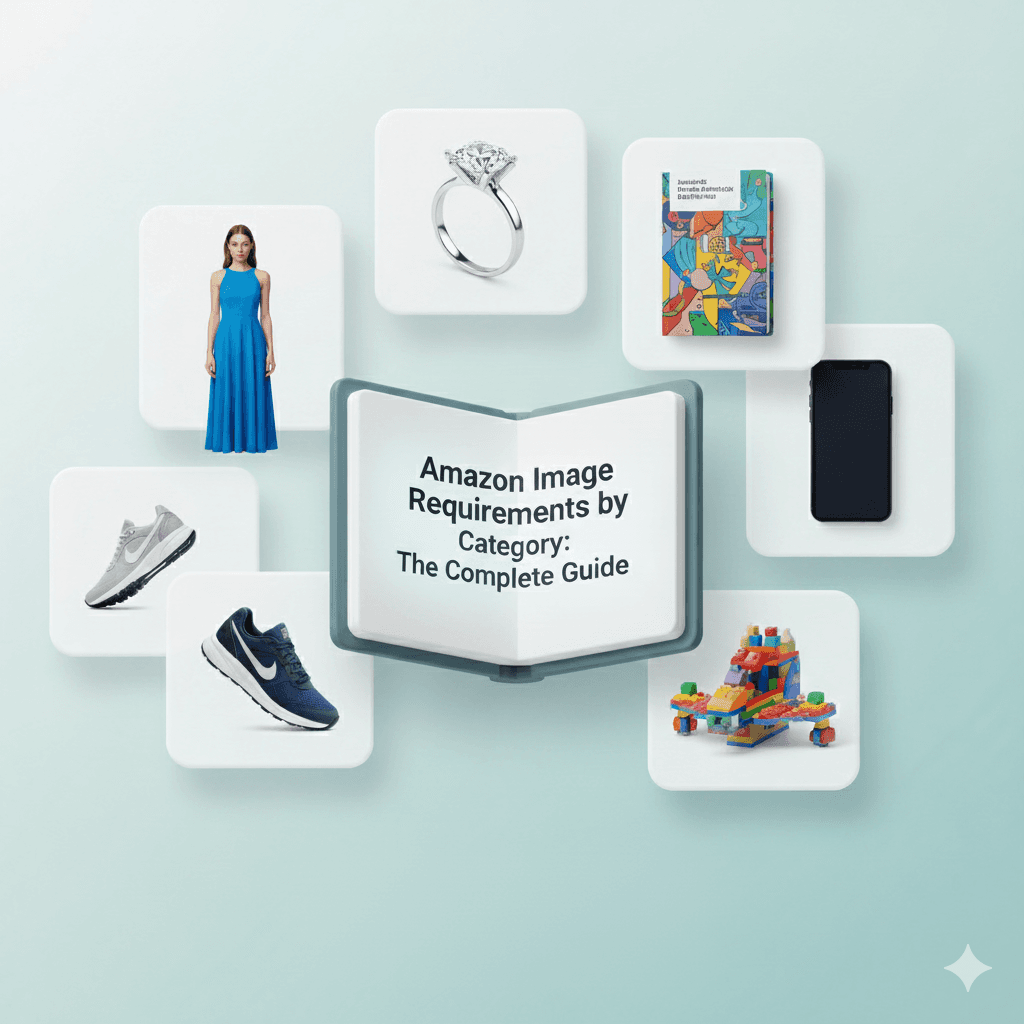
Amazon Image Requirements by Category: The Complete Guide
by David Hunter
The Rule That Changes Everything
You've mastered Amazon's general image requirements. Pure white background. 2000x2000 pixels. Product fills 85% of the frame. Square aspect ratio.
You photograph your product following every rule perfectly.
Rejection: "Main image does not meet category requirements."
Wait, what? There are category-specific rules too?
Yes. And they override the general rules.
Amazon doesn't just have one set of image requirements. Different product categories have their own unique rules—and some of them directly contradict the general guidelines.
What works for electronics gets your clothing listing rejected. What's required for shoes is prohibited for jewelry. What's perfect for books violates the rules for kids' apparel.
If you don't know your category's specific requirements, you'll waste time creating images that Amazon automatically rejects.
In this guide, I'll explain:
- Why Amazon has category-specific rules
- The major categories with unique requirements
- Specific rules for clothing, shoes, jewelry, books, and more
- How to find requirements for your specific category
- Common cross-category mistakes sellers make
Let's make sure you know YOUR category's rules.
Why Amazon Has Category-Specific Rules
Customer Shopping Behavior Varies by Product Type
Amazon's category-specific image rules aren't arbitrary. They're based on extensive research into how customers shop for different types of products.
For clothing:
- Customers want to see how it fits on a real person
- They need to see drape, length, and how fabric moves
- A flat photo doesn't show fit or style
Solution: Require models for adult clothing
For jewelry:
- Customers want extreme close-ups to see craftsmanship
- They want to examine details: stones, settings, engravings
- A model's hand is a distraction from the product
Solution: Prohibit models, allow 100% frame fill and cropping for detail
For shoes:
- Customers want to compare styles side-by-side in search results
- They need a consistent viewing angle across all products
- Random angles make comparison difficult
Solution: Standardize on 45-degree left-facing angle for all shoes
Each category's rules optimize the customer experience for that specific type of product.
Creating a Level Playing Field Within Categories
Category-specific rules also ensure fair competition.
If some clothing sellers could use mannequins (cheaper, easier) while others had to hire models, the playing field wouldn't be level.
By standardizing requirements within each category, Amazon ensures:
- All sellers in a category compete on equal visual terms
- Customers can easily compare similar products
- Search results look professional and consistent
Clothing & Apparel Categories
Adult Clothing (Men's & Women's)
Category includes: Shirts, pants, dresses, suits, activewear, outerwear, swimwear
Main image requirements:
✅ Must use a human model (not a mannequin, not flat)
✅ Model must be standing (not sitting, kneeling, or lying down)
✅ Show the full product (don't crop off sleeves, hem, etc.)
✅ Model should be facing forward (frontal view of the garment)
✅ Pure white background (RGB 255,255,255)
✅ Product must be the focus (not the model's face)
❌ Cannot use mannequins (including invisible/ghost mannequins)
❌ Cannot photograph flat (no lay-flat shots for main image)
❌ Cannot show multiple items (one product per main image)
❌ No props or accessories (unless they're part of the product being sold)
Why these rules:
Customers buying clothing need to see:
- How the garment fits on a real body
- How fabric drapes and moves
- The actual length and proportions
- Style and silhouette
A mannequin or flat photo can't show these critical details.
Example:
Selling a women's dress:
- ✓ Photo of woman standing, facing forward, wearing the dress
- ✗ Photo of dress on mannequin
- ✗ Photo of dress laid flat on white background
- ✗ Photo of dress on hanger
Secondary images: Can show close-ups of fabric, back view, additional styling
Kids' & Baby Clothing
Category includes: Infant clothing, toddler clothes, kids' apparel
Main image requirements:
✅ Must be photographed flat (laid out on white surface)
✅ No model allowed (not even a baby or child)
✅ No mannequin or form (completely flat)
✅ Pure white background
✅ Show front view of garment
❌ Cannot use models (children or adults)
❌ Cannot use infant mannequins or forms
❌ Cannot show on hangers
Why the difference from adult clothing:
Amazon has strict policies about images of children:
- Protects children's privacy and safety
- Avoids potential inappropriate use of children's images
- Eliminates concerns about age-appropriate modeling
The flat requirement is a safety policy, not a customer experience choice.
Example:
Selling a baby onesie:
- ✓ Onesie laid flat on white background, front view
- ✗ Baby wearing the onesie
- ✗ Onesie on infant mannequin
- ✗ Parent holding baby in onesie
Special note for undergarments:
Kids' and baby underwear, swimwear, and leotards must also be photographed flat. This rule is even more strictly enforced for these items.
Clothing Accessories
Category includes: Scarves, belts, hats, gloves, ties
Main image requirements:
More flexible than full garments:
- Can be shown flat
- Can be shown on mannequin (for items that drape, like scarves)
- Can be shown on a stand (for hats)
- Still require pure white background
Example:
Selling a scarf:
- ✓ Scarf laid flat showing pattern
- ✓ Scarf draped on invisible mannequin showing how it hangs
- ✗ Person wearing the scarf (save for secondary images)
Shoes & Footwear
The 45-Degree Left-Facing Rule
Category includes: All footwear (sneakers, boots, heels, sandals, slippers)
Main image requirements:
✅ Show a single shoe (not a pair—just one left shoe)
✅ Position at 45-degree angle
✅ Facing to the LEFT (toe pointing left side of frame)
✅ Pure white background
✅ No model or mannequin
❌ Cannot show both shoes (pair) in main image
❌ Cannot show shoe facing right
❌ Cannot show shoe on a foot or model
❌ Cannot use props (no shoe boxes, tissue paper, etc.)
Why this specific angle:
The 45-degree left-facing angle:
- Shows the shoe's profile and top simultaneously
- Allows customers to see shape, height, and design details
- Creates consistency across all shoe listings in search results
- Makes side-by-side comparison easy
Visualizing the angle:
        ┌─────────────────────┐
        │                     │
        │    ╱───╲            │
        │   ╱     ╲           │
        │  │  SHOE │          │
        │   ╲     ╱           │
        │    ╲───╱            │
        │   ← 45°             │
        │ (facing left)       │
        └─────────────────────┘
Example:
Selling running shoes:
- ✓ Left shoe at 45-degree angle, facing left
- ✗ Both shoes shown as a pair
- ✗ Right shoe facing right
- ✗ Shoe facing camera head-on
Secondary images: Can show the pair, different angles, shoes being worn, sole view
Jewelry
The No-Model Rule
Category includes: Rings, necklaces, bracelets, earrings, watches
Main image requirements:
✅ Product only (no models, no hands, no mannequins)
✅ Pure white background
✅ Can fill up to 100% of frame (unlike most categories at 85%)
✅ Can be cropped by edges (to show extreme close-up detail)
✅ Focus on craftsmanship and detail
❌ Cannot show on a model (no hands, necks, wrists, ears)
❌ Cannot use jewelry busts or mannequins
❌ Cannot include props (no jewelry boxes, stands visible)
Why these rules:
Jewelry customers care about:
- Craftsmanship and detail (stone quality, settings, engravings)
- Exact design and proportions
- Material finish and color
A model distracts from these details.
Additionally, allowing 100% frame fill (and even cropping) lets sellers show extreme close-ups that reveal quality.
Example:
Selling a diamond ring:
- ✓ Ring photographed alone, extreme close-up showing stones
- ✓ Ring filling 95% of frame, slightly cropped at edges
- ✗ Ring on a hand/finger
- ✗ Ring on a jewelry display bust
Secondary images: Can show jewelry being worn (ring on hand, necklace on neck) to demonstrate size and appearance when used
Special note: This is one of the few categories where cropping the product (cutting off edges) is explicitly allowed in the main image.
Books, Music & Video/DVD
The Cover Art Rule
Category includes: Physical books, CDs, DVDs, Blu-rays, vinyl records
Main image requirements:
✅ Show the cover art/packaging
✅ Cover should fill 100% of the frame (no white space around it)
✅ Front cover only (not spine or back)
✅ High-resolution image of the actual cover
❌ No white borders around the cover
❌ No mockups or illustrations (must be actual product)
❌ No additional text or graphics overlaid on cover
Why these rules:
For books and media:
- The cover IS the product's identity
- Customers recognize books by their cover art
- Cover design is a key purchase factor
- White space around covers looks unprofessional
Example:
Selling a hardcover book:
- ✓ Book cover filling entire 2000x2000 frame (no white space)
- ✗ Book cover in center with white background around it
- ✗ Book photographed at an angle showing spine and cover
- ✗ Stock illustration of a generic book
Technical note:
This is an exception to the "85% fill rule." For books/media, the cover should fill 100% of the frame—edge to edge.
Secondary images: Can show back cover, inside pages, author photo, book on shelf, etc.
Electronics & Accessories
Category includes: Phones, tablets, cameras, headphones, cables, chargers
Main image requirements:
Electronics mostly follow general rules with a few nuances:
✅ Product only (no packaging, no accessories unless included in sale)
✅ Pure white background
✅ Show product powered off (blank screens preferred)
✅ Single product (not multiple units unless it's a multi-pack)
✅ No hands holding the product (save for secondary images)
❌ Cannot show retail packaging in main image (no boxes)
❌ Cannot include cables/chargers unless they're part of the sale
❌ Cannot show screen content that includes text or graphics (if avoidable)
Why these rules:
Electronics customers want to see:
- The physical product design
- Build quality and finish
- Ports, buttons, and features
- Size and proportions
Packaging, accessories, and screen content distract from the product itself.
Example:
Selling wireless headphones:
- ✓ Headphones alone on white background
- ✗ Headphones in retail box
- ✗ Headphones with charging cable and manual spread out
- ✗ Person wearing headphones
Screen display nuance:
For products with screens (phones, tablets, smartwatches):
- Main image should show device with blank/off screen or a neutral display
- Don't show branded apps, personal photos, or copyrighted content on screen
- Secondary images can show the screen in use
Toys & Games
Category includes: Action figures, dolls, board games, puzzles, building sets
Main image requirements:
Toys generally follow standard rules:
✅ Show the product (not the packaging, unless packaging is the product)
✅ Pure white background
✅ Product must be assembled/ready to use (not in pieces)
✅ No children in main image (safety policy, same as kids' clothing)
❌ Cannot show product in retail box (unless the box itself is collectible)
❌ Cannot include batteries, instructions, or accessories unless included in sale
❌ Cannot show children using the toy
Example:
Selling a building block set:
- ✓ Completed model built from the set
- ✗ Unassembled pieces scattered on white background
- ✗ Product still in retail packaging
- ✗ Child playing with the set
Board game exception:
Board games and puzzles can show the box/packaging as the main image if that's how the product is sold and recognized.
Secondary images: Can show the toy in use (by adults), scale reference, included pieces, packaging
Home & Kitchen
Category includes: Cookware, appliances, furniture, decor, bedding
Main image requirements:
Home goods mostly follow general rules:
✅ Product only on white background
✅ Show product ready to use (pot with lid on, lamp assembled)
✅ No lifestyle/contextual elements in main image
❌ Cannot show product in a kitchen or room setting in main image
❌ Cannot include food, flowers, or decorative items (unless they're part of the sale)
Why these rules:
Main image needs to show the product clearly for comparison shopping.
Example:
Selling a mixing bowl:
- ✓ Bowl alone on white background
- ✗ Bowl filled with ingredients in a kitchen
- ✗ Bowl with whisk and measuring cups around it
Exception for furniture:
Large furniture items may be shown in minimal context (e.g., dining chair on white background, but slight shadow/floor visible for grounding). This is a practical exception since furniture needs to show scale.
Secondary images: Use lifestyle images showing the product in use, in a room, with food in the bowl, etc.
Beauty & Personal Care
Category includes: Cosmetics, skincare, hair care, fragrances, grooming tools
Main image requirements:
Beauty products follow standard rules with packaging nuances:
✅ Show the product as customers will receive it
✅ Can show product in its container/bottle/packaging
✅ Pure white background
✅ No hands, models, or skin in main image
❌ Cannot show product applied to skin in main image
❌ Cannot show before/after results in main image
❌ Cannot include applicators unless part of the product
Why these rules:
Beauty product main images need to show:
- The actual packaging customers will receive
- Product color (lipstick shade, etc.)
- Size and format (bottle, tube, jar)
Example:
Selling lipstick:
- ✓ Lipstick in its tube, cap off, showing color
- ✗ Lipstick swatched on skin or lips
- ✗ Model wearing the lipstick
- ✗ Lipstick with makeup brush as prop
Fragrance exception:
Perfumes/colognes should show the bottle on white background. If the product comes in a decorative box (especially luxury fragrances), you can show the bottle AND box together.
Secondary images: Can show product swatches, application, results, texture close-ups
Pet Supplies
Category includes: Pet food, toys, grooming tools, beds, carriers
Main image requirements:
✅ Product only on white background
✅ Show product as customer receives it (unopened bag of food, assembled pet bed)
❌ Cannot show pets using the product in main image
Why:
Main image needs to show the product itself for comparison.
Example:
Selling a dog toy:
- ✓ Toy alone on white background
- ✗ Dog playing with toy
- ✗ Toy in packaging
- ✗ Hand holding toy for scale
Secondary images: Show pets using the product, demonstrate size, show features
How to Find Your Category's Specific Requirements
Method 1: Amazon Seller Central Help
- Log into Seller Central
- Click Help (top right)
- Search: "Product image requirements [your category]"
- Example: "Product image requirements clothing"
- Amazon provides detailed style guides for major categories
Method 2: Category Listing Quality Dashboard
- Go to Inventory → Manage Inventory
- Find a product in your category
- Click Edit
- Scroll to Images section
- Look for category-specific guidelines or warnings
Method 3: Browse Top Competitors
- Search for top-selling products in your category
- Examine their main images
- Look for patterns:
- Are all clothing items on models?
- Are all shoes at the same angle?
- Are all jewelry items shot without models?
- These patterns reveal category requirements
Don't blindly copy competitors, but use their images to understand what Amazon accepts in your category.
Method 4: Contact Seller Support
If you can't find clear documentation:
- Open a case with Seller Support
- Ask: "What are the main image requirements for [your specific category]?"
- Request official documentation or links
Get it in writing so you have reference if your images are later rejected.
Common Cross-Category Mistakes
Mistake #1: Using General Rules for a Category with Exceptions
The problem:
You read Amazon's general image guidelines (white background, 85% fill, etc.) and apply them to adult clothing.
You photograph your dress on a mannequin on white background.
Rejection: Adult clothing requires a human model.
The fix:
Always check if your category has specific requirements that override general guidelines.
Mistake #2: Using Another Category's Rules
The problem:
You sell both jewelry and clothing. You know clothing needs models, so you photograph a necklace on a model's neck.
Rejection: Jewelry cannot use models.
The fix:
Rules don't transfer between categories. Each category has its own requirements.
Mistake #3: Assuming "If It Looks Good, It's Compliant"
The problem:
Your shoe image is beautifully photographed—both shoes shown as a pair, angled artistically to the right.
Rejection: Shoes must show single shoe, 45-degree angle, facing LEFT.
The fix:
"Good photography" ≠ "compliant photography." Follow the category rules even if they seem arbitrary.
Mistake #4: Ignoring Category When Using Stock Photos
The problem:
You're dropshipping. You use the supplier's stock photo showing the product in packaging.
Rejection: Main image must show product only, not packaging.
The fix:
If you're using stock photos, verify they meet YOUR category's requirements. Supplier photos often don't.
What If My Product Fits Multiple Categories?
Example: A fitness tracker
Could be:
- Electronics (it's a tech device)
- Sports & Outdoors (used for fitness)
- Health & Household (tracks health metrics)
Amazon's classification determines which rules apply.
How to check your product's official category:
- Go to your listing in Manage Inventory
- Look at the Browse Node or Category field
- This shows Amazon's official classification
If your product is misclassified:
Contact Seller Support to request a category change. Provide justification for why the product belongs in a different category.
But once classified, you MUST follow that category's image rules.
Summary: Key Takeaways
✅ Category rules override general rules (always check your specific category)
✅ Adult clothing: Requires human models standing upright
✅ Kids' clothing: Must be photographed flat (no models)
✅ Shoes: Single shoe, 45-degree angle, facing left
✅ Jewelry: No models or mannequins, can fill 100% of frame
✅ Books/Media: Cover art fills 100% of frame (no white space)
✅ Electronics: Product only, no packaging, blank screens preferred
✅ Check Seller Central: Search for "[category] image requirements"
✅ Secondary images: Have more flexibility than main images
Amazon's category-specific rules exist to optimize the shopping experience for each product type. Knowing your category's unique requirements saves time and prevents rejections.
Need to verify your images meet both general AND category-specific requirements? ComplianceKit checks all rules for your product category automatically.
Related Articles
Need help checking your Amazon images?
Try ComplianceKit free - 10 checks & 3 fixes, no credit card required.
Check Your Images Free →