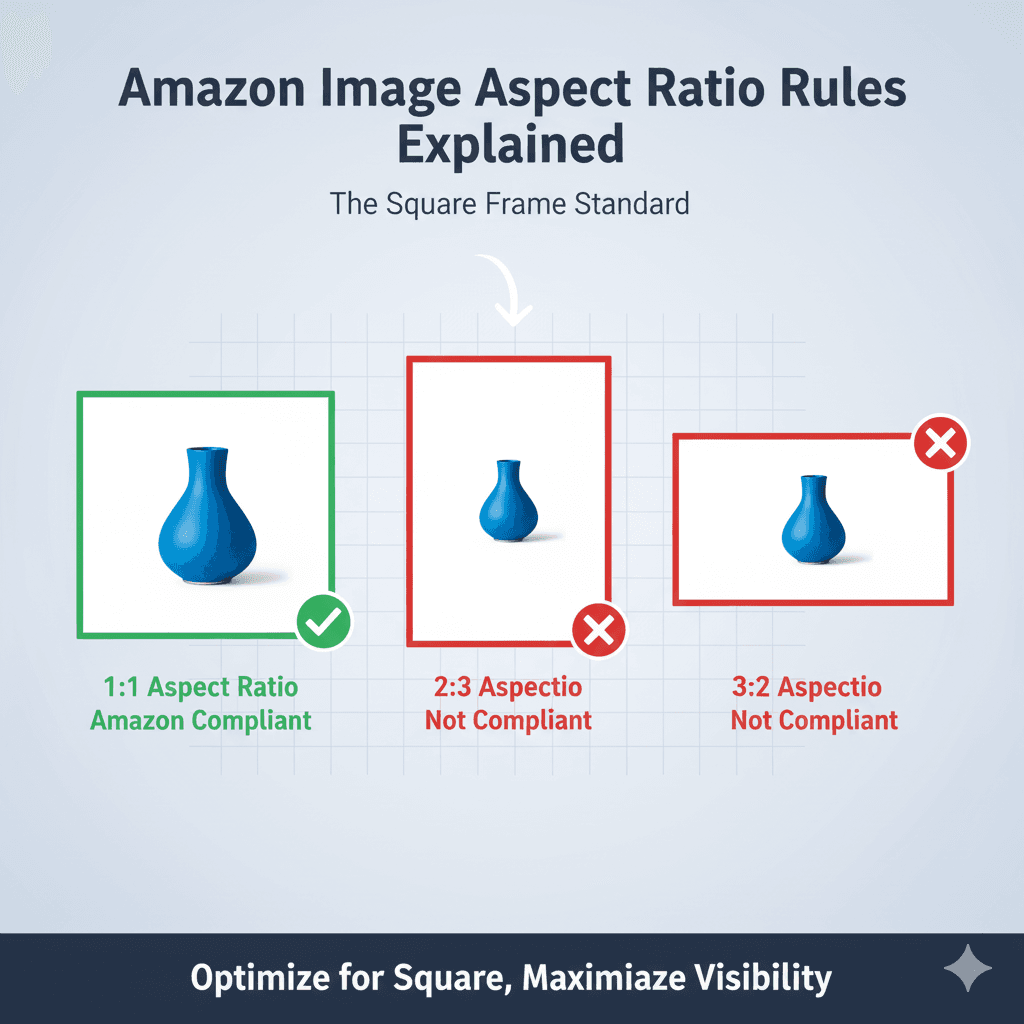
Amazon Image Aspect Ratio Rules Explained
by David Hunter
The Shape Rule That Catches Everyone
Your product photo looks great. It's high resolution. Pure white background. You upload to Amazon.
Rejection: "Image aspect ratio does not meet requirements."
Aspect ratio? What does that even mean?
Amazon doesn't just care about image size. It also cares about image shape—the proportion of width to height.
Upload an image that's too wide, too tall, or weirdly shaped, and Amazon rejects it. Even if everything else is perfect.
In this guide, we'll explain:
- What aspect ratio actually means
- Amazon's preferred aspect ratios (and which to avoid)
- Why square (1:1) images work best
- When non-square ratios are acceptable
- Common aspect ratio mistakes that trigger rejections
- How to fix aspect ratio issues without cropping your product
Let's make sure your images have the right shape for Amazon.
What Is Aspect Ratio?
Aspect Ratio = Width ÷ Height
Aspect ratio describes the proportional relationship between an image's width and height.
It's written as two numbers separated by a colon, like 1:1 or 4:3.
Examples:
- 2000x2000 pixels = 2000 ÷ 2000 = 1:1 (square)
- 2000x1500 pixels = 2000 ÷ 1500 = 4:3 (landscape)
- 1500x2000 pixels = 1500 ÷ 2000 = 3:4 (portrait)
Why Aspect Ratio Matters
Aspect ratio determines how your image displays on Amazon.
- Square images (1:1) display consistently everywhere
- Slightly rectangular (4:3, 3:4) work but may get cropped
- Extreme ratios (3:1, 1:3) get rejected or look distorted
Amazon prefers images that are close to square because they fit cleanly in:
- Search result thumbnails (square)
- Product page main image (mostly square)
- Mobile displays (variable shapes)
If your image is too wide or too tall, it creates display issues.
Amazon's Preferred Aspect Ratios
Best: 1:1 (Square)
Dimensions: 2000x2000, 2500x2500, 3000x3000
Why it works:
- Displays perfectly in search results
- No cropping on product pages
- Looks great on mobile and desktop
- Works for 95% of products
This is Amazon's ideal. If you can make your product image square, do it.
Acceptable: 4:3, 3:4, 5:4, 4:5
4:3 (Landscape): 2000x1500, 2400x1800 3:4 (Portrait): 1500x2000, 1800x2400 5:4 (Slightly wide): 2500x2000, 2000x1600 4:5 (Slightly tall): 2000x2500, 1600x2000
Why they're acceptable:
These ratios are close to square. Amazon can display them without major cropping or distortion.
When to use:
- Your product is naturally rectangular (tall bottle, wide monitor)
- Cropping to square would cut off important product details
- Adding white space to make it square would create excessive padding
Avoid: 16:9, 9:16 (Too Extreme)
16:9 (Widescreen): 1920x1080, 2560x1440 9:16 (Vertical video): 1080x1920, 1440x2560
Why Amazon dislikes these:
- Too wide or too tall for product display
- Gets cropped heavily in search results
- Looks distorted on product pages
- These ratios are designed for video, not product photos
Result: May be rejected, or if accepted, will look bad on Amazon.
Never: Panoramic or Extreme Ratios
Examples: 3:1 (Ultra-wide): 3000x1000 1:3 (Ultra-tall): 1000x3000
Why Amazon rejects these:
Too extreme. Can't display properly anywhere on Amazon. Automatic rejection.
Even if your product is extremely wide (like a yoga mat), don't use a 3:1 ratio. Add white space to bring it closer to square.
Why Square (1:1) Works Best
1. Consistent Display Across All Devices
Amazon displays your image in multiple places:
- Desktop search results (square thumbnails)
- Mobile search results (square thumbnails)
- Product page main image (mostly square)
- Shopping cart (square)
- "Customers also bought" section (square)
Square images (1:1) fit perfectly everywhere.
Non-square images get cropped or padded, which can cut off important product details.
2. No Cropping Issues
When Amazon displays a non-square image in a square space (like search results), it has two options:
Option A: Crop the image (cuts off edges) Option B: Add padding (creates blank space)
Both options are bad.
With a square image, no cropping or padding needed. Your product displays exactly as you intended.
3. Professional Appearance
Square images look intentional and professional.
Non-square images can look:
- Amateurish (like you didn't know the requirements)
- Inconsistent (different ratios across your catalog)
- Poorly composed (product too small or poorly framed)
Square images signal: "This seller knows what they're doing."
4. Easier to Create
Most photo editing tools default to square canvases:
- Photoshop: 2000x2000
- Canva: Square template
- Phone apps: Square crop
Working in square from the start saves time and ensures consistency.
When Non-Square Is Okay
Tall Products: 4:5 Portrait Acceptable
Examples: Bottles, lamps, tall vases, floor lamps, yoga mats (rolled), tall storage bins
Recommended ratio: 4:5 (e.g., 2000x2500)
Why it's okay:
Your product is naturally tall. Using a portrait ratio lets you show the full product without excessive white space at top and bottom.
But: If possible, still prefer square (1:1). Add white space on sides to make it square.
Wide Products: 5:4 Landscape Acceptable
Examples: Monitors, keyboards, wide rugs, wall art (landscape), wide shelving
Recommended ratio: 5:4 (e.g., 2500x2000)
Why it's okay:
Your product is naturally wide. Using a landscape ratio shows the full width without excessive side padding.
But: If possible, add white space above and below to make it square.
Always Prefer Square If Possible
Even for tall or wide products, square is still best.
How to make non-square products work in a square frame:
- Add white space (padding) around the product
- Keep the product large enough to see details
- Center the product in the square frame
Example:
Tall bottle (naturally 1:2 ratio)
Bad approach: Upload as 1000x2000 (too tall) Good approach: Add white space, upload as 2000x2000 (square)
The bottle takes up the vertical space, white space fills the sides. Product is still clearly visible, but the image is square.
Common Aspect Ratio Mistakes
Mistake #1: Extreme Ratios
The Problem:
You photograph a wide product (like a yoga mat) and upload a 3000x1000 image (3:1 ratio).
Amazon: "Image aspect ratio exceeds acceptable limits." REJECTED.
The Fix:
Add white space above and below the product to create a more square ratio:
- Original: 3000x1000 (3:1)
- Fixed: 3000x2400 (5:4) or 3000x3000 (1:1)
Mistake #2: Different Ratios for Different Images
The Problem:
Your listing has 7 images:
- Main image: 2000x2000 (1:1)
- Image 2: 2000x1500 (4:3)
- Image 3: 1500x2000 (3:4)
- Image 4: 2500x2000 (5:4)
Result: Your listing looks inconsistent. Images are different shapes, creating a disjointed experience.
The Fix:
Use the same aspect ratio for ALL images. Preferably 1:1 (square).
Consistency creates a professional, cohesive listing.
Mistake #3: Cropping Important Parts of Product
The Problem:
Your product is wide. To make it square, you crop the left and right edges.
Result: Key product features (buttons, labels, connectors) are cut off.
The Fix:
Don't crop the product. Instead, add white space around it to create a square frame.
How to Adjust Aspect Ratio
Method 1: Crop to Square (Use Carefully)
When to use:
Your image has excess background and the product itself fits nicely in a square crop.
How to do it:
Photoshop:
- Select Crop Tool (C)
- Set aspect ratio to 1:1 (square)
- Adjust crop to frame your product
- Make sure no important details are cut off
- Crop
Canva:
- Upload image
- Use crop tool, select "Square"
- Adjust framing
- Download
Warning: Only crop if you're removing excess background. Never crop into your product.
Method 2: Add White Space (Recommended)
When to use:
Your product is non-square (tall or wide), and cropping would cut off important details.
How to do it:
Photoshop:
- Image → Canvas Size
- Set new dimensions to make it square (e.g., 2000x2500 → 2500x2500)
- Anchor: Center
- Canvas extension color: White (#FFFFFF)
- Click OK
Result: White space is added around your product, making the image square without cropping.
Canva:
- Create new design (2000x2000)
- Set background to white
- Upload your product image
- Resize/position product in center
- Download
Method 3: Resize Product Within Square Frame
When to use:
Your product image is already square, but the product itself is too large or poorly positioned.
How to do it:
Photoshop:
- Create new 2000x2000 canvas (white background)
- Paste your product image on a new layer
- Transform (Ctrl+T / Cmd+T)
- Resize product to fit nicely within frame
- Center it
- Flatten and export
This gives you full control over product size and positioning within a square frame.
Real Examples: Before & After
Example 1: Wide Product (Yoga Mat)
Before: Image: 3000x1000 (3:1 ratio, too wide) Amazon: REJECTED
After: Image: 3000x2400 (5:4 ratio) Added white space above and below mat Amazon: APPROVED
Fix used: Photoshop Canvas Size, added 700px top and bottom
Example 2: Tall Product (Wine Bottle)
Before: Image: 1000x2500 (2:5 ratio, too tall) Amazon: REJECTED
After: Image: 2500x2500 (1:1 ratio) Added white space on left and right sides Amazon: APPROVED
Fix used: Canva, placed bottle image on 2500x2500 white canvas
Example 3: Inconsistent Ratios
Before: Listing with mixed ratios (1:1, 4:3, 16:9) Amazon: Some images rejected, listing looks messy
After: All images converted to 2000x2000 (1:1) Amazon: All approved, listing looks professional
Fix used: Batch processed all images to square in Photoshop
Quick Aspect Ratio Verification
Before uploading to Amazon, verify your aspect ratio:
Manual check:
- Check image dimensions (right-click → Properties)
- Divide width by height
- Common results:
- 2000 ÷ 2000 = 1 → 1:1 (perfect)
- 2000 ÷ 1500 = 1.33 → 4:3 (acceptable)
- 3000 ÷ 1000 = 3 → 3:1 (too wide, will be rejected)
Automated check:
Upload to ComplianceKit to instantly verify aspect ratio, dimensions, and all other compliance requirements. Get pass/fail results in seconds and know exactly what needs fixing before you upload to Amazon.
Summary: Key Takeaways
✅ Best ratio: 1:1 (square) — works for all products
✅ Acceptable: 4:3, 3:4, 5:4, 4:5 (close to square)
✅ Avoid: 16:9, 9:16 (too extreme)
✅ Never: 3:1, 1:3, panoramic ratios
✅ Fix method: Add white space, don't crop product
✅ Consistency: Use same ratio for all images in your listing
Square images display perfectly everywhere on Amazon. When in doubt, make it square.
Need to verify your aspect ratios meet Amazon's requirements? ComplianceKit checks dimensions, ratios, and all compliance issues instantly.
Related Articles
Need help checking your Amazon images?
Try ComplianceKit free - 10 checks & 3 fixes, no credit card required.
Check Your Images Free →