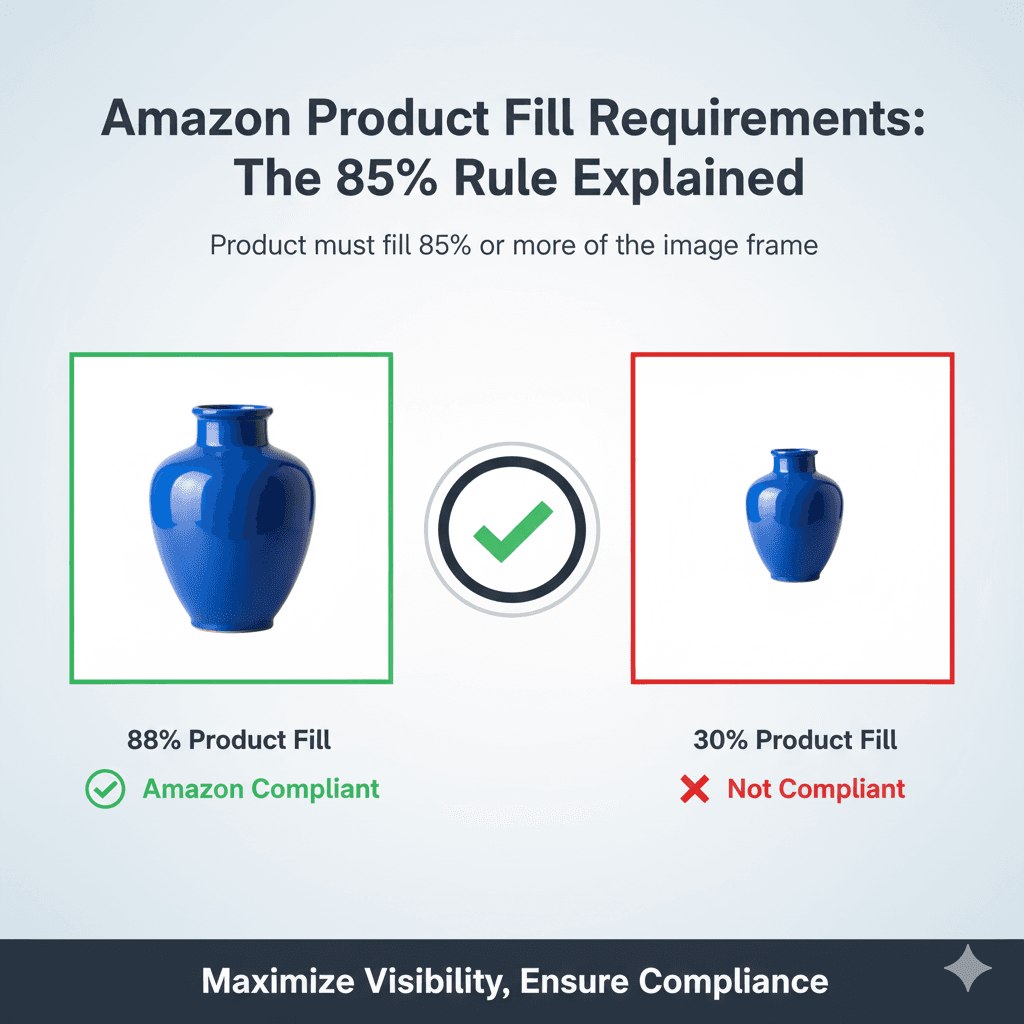
Amazon Product Fill Requirements: The 85% Rule Explained
by David Hunter
The Framing Rule Nobody Knows About
Your product image meets every requirement. Pure white background. Perfect 2000x2000 dimensions. Square aspect ratio. You upload it to Amazon.
Rejection: "Product does not fill enough of the image frame."
What? The product is centered. It's clearly visible. What's the problem?
The problem: Your product is too small.
Amazon doesn't just want to see your product. Amazon wants your product to dominate the frame—filling at least 85% of the image area.
If your product is a tiny object floating in a sea of white space, it gets rejected. Even if everything else is perfect.
This is called the 85% rule, and it's one of Amazon's most misunderstood requirements.
In this guide, I'll explain:
- What the 85% rule actually means (with visual examples)
- Why Amazon enforces this requirement
- How to measure if your product fills 85% of the frame
- How to properly frame products of different shapes
- Common framing mistakes that cause rejections
- How to balance fill requirements with aspect ratio rules
- When less than 85% is acceptable
Let's make sure your products are framed correctly for Amazon.
What Is the 85% Rule?
The Official Requirement
Amazon states: "The product should fill 85% or more of the image area."
This means the product itself—not including white space, shadows, or background—must occupy at least 85% of the total image dimensions.
Breaking Down the Math
For a 2000x2000 pixel image:
- Total image area: 2000px × 2000px
- 85% of width: 2000 × 0.85 = 1700px
- 85% of height: 2000 × 0.85 = 1700px
Your product should measure at least 1700x1700 pixels within the 2000x2000 frame.
This leaves:
- 150 pixels of white space on each side (left and right)
- 150 pixels of white space top and bottom
Visual Example
Imagine a 2000x2000 image as a square box.
Compliant (85% fill):
┌────────────────────────┐
│    [150px margin]      │
│  ┌──────────────────┐  │
│  │                  │  │
│  │    PRODUCT       │  │
│  │   1700x1700px    │  │
│  │                  │  │
│  └──────────────────┘  │
│    [150px margin]      │
└────────────────────────┘
Non-compliant (product too small):
┌────────────────────────┐
│                        │
│     ┌──────────┐       │
│     │ PRODUCT  │       │
│     │ 1200px   │       │
│     └──────────┘       │
│                        │
└────────────────────────┘
The second example has too much white space. The product occupies only 60% of the frame. Amazon rejects it.
Why Amazon Enforces the 85% Rule
Reason #1: Mobile Thumbnail Visibility
Over 70% of Amazon shopping happens on mobile devices.
On a phone screen, search results show tiny thumbnails—often as small as 100x100 pixels displayed on screen.
If your product only fills 60% of the original image:
- The product in the thumbnail becomes 60 pixels wide
- Customers can barely see details
- Your listing gets fewer clicks
If your product fills 85% of the original image:
- The product in the thumbnail is 85 pixels wide
- Details are visible and recognizable
- Your listing gets more clicks
Bigger product in frame = more visible in thumbnails = higher click-through rate.
Reason #2: Competitive Fairness
Amazon wants all products to compete on equal visual terms.
If one seller uploads a product that fills the entire frame and another uploads a product floating in white space, the first seller has a massive visibility advantage in search results.
By requiring 85% fill, Amazon creates:
- Consistent product visibility across all listings
- Fair competition based on product quality, not image tricks
- Professional-looking search results page
Reason #3: Customer Experience
Customers expect to see the product clearly when they click a listing.
A main image with excessive white space looks:
- Unprofessional (like you don't know what you're doing)
- Low-quality (suggests the product is cheap or poorly made)
- Confusing (is the product really that small?)
The 85% rule ensures customers can immediately see what they're buying.
How to Measure Product Fill Percentage
Method 1: Photoshop Measurement
Steps:
- Open your image in Photoshop
- Select the Rectangular Marquee Tool (M key)
- Draw a selection box around the product's outermost edges
- Include the entire product
- Don't include white space beyond the product
- Look at the Info Panel (Window → Info if not visible)
- Check the W (width) and H (height) of your selection
Calculate fill percentage:
For a 2000x2000 image:
- If selection shows W: 1800px, H: 1800px
- Fill percentage: 1800 ÷ 2000 = 90% ✓ (passes)
For a 2000x2000 image:
- If selection shows W: 1600px, H: 1600px
- Fill percentage: 1600 ÷ 2000 = 80% ✗ (fails—needs to be 85%+)
Method 2: Visual Grid Method
Quick visual check:
- Open your image
- Mentally divide the image into a 5x5 grid (or use grid overlay in Photoshop)
- Your product should extend beyond the inner 4x4 squares
If your product stays within the center 3x3 or 4x4 area, it's too small.
Method 3: Automated Check
Use ComplianceKit:
- Upload your image
- Tool automatically measures product boundaries
- Calculates fill percentage
- Instant pass/fail: "Product fills 78% of frame (needs 85%)"
- Visual overlay shows exactly how much more the product needs to fill
This eliminates guesswork and manual measurement.
How to Properly Frame Different Product Types
Square Products (Easy)
Examples: Boxes, plates, board games, square pillows
Framing strategy:
Square products are the easiest to frame for 85% fill.
- Place product centered in the frame
- Ensure product edges come close to image edges
- Leave ~150px margin on all sides for a 2000x2000 image
Example:
Product: 1800x1800px Canvas: 2000x2000px Fill: 90% ✓
Tall Products (Bottles, Lamps)
Challenge: If you add white space on the sides to make the image square (for aspect ratio), the product might not fill 85% anymore.
Solution:
Use a portrait orientation (4:5 ratio) where the product naturally fits:
- Canvas: 2000x2500px (portrait)
- Product: 1700x2125px (fills 85% of both dimensions)
Alternative:
If you must use square canvas:
- Canvas: 2500x2500px (larger square)
- Product: 1700x2125px (tall product)
- Add white space on sides
- Product still fills 85% of height, even if width is less
The rule applies to BOTH dimensions. If your product fills 85% height but only 60% width, it may be acceptable for tall products.
Wide Products (Keyboards, Monitors)
Challenge: Similar to tall products—adding white space to meet aspect ratio can reduce fill percentage.
Solution:
Use a landscape orientation (5:4 ratio):
- Canvas: 2500x2000px (landscape)
- Product: 2125x1700px (fills 85% of both dimensions)
Alternative:
Larger square canvas:
- Canvas: 2500x2500px
- Product: 2125x1700px (wide product)
- Add white space above/below
- Product fills 85% width, acceptable even if height is less
Small Products (Jewelry, Small Electronics)
Challenge: The physical product is tiny. If you photograph it actual size, it won't fill 85%.
Solution:
Photograph the product LARGER than actual size.
Use macro photography or crop tightly to make the small product fill the frame.
Example:
A ring that's actually 0.5 inches wide:
- Don't photograph it at actual size (it would be tiny in frame)
- Use macro lens or crop to make the ring 1700+ pixels wide in the image
- The product fills 85% of the frame
For scale reference: Use secondary images showing the ring on a hand or next to a common object.
Products with Accessories
Challenge: Does the 85% rule apply to the entire scene (product + accessories) or just the main product?
Amazon's intent: The main product for sale should fill 85%.
Example:
Selling a camera. Including a lens cap, strap, and manual in the photo.
Correct framing:
- The camera itself should fill 85% of the frame
- Accessories can be shown but shouldn't dominate the composition
If you show the camera, lens, battery, charger, case, and manual all spread out:
- The camera only fills 40% of the frame
- Amazon may reject it for not meeting 85% rule
Better approach:
- Main image: Camera fills 85% of frame, no accessories
- Secondary image: "What's in the box" shot showing all accessories
Common Product Fill Mistakes
Mistake #1: Too Much White Space
The problem:
You center your product in a 2000x2000 canvas, but the product is only 1200x1200 pixels.
Result: Product fills 60% of frame. Too much white space. Rejected.
The fix:
Either:
- Zoom in on the product when photographing (fill more of the camera frame)
- Crop the image tighter in post-processing
- Use a smaller canvas size (if product is 1200x1200, use a 1400x1400 canvas)
Mistake #2: Adding Too Much White Space for Aspect Ratio
The problem:
Your product is wide (3000x1500). You add white space above and below to make it square (3000x3000).
Now the product fills 50% of the height dimension.
The fix:
Use a landscape aspect ratio (5:4) instead of forcing it to square:
- Original: 3000x1500 (2:1 ratio, too wide)
- Add white space: 3000x2400 (5:4 ratio, acceptable)
- Product fills 62.5% of height (better, but still might be too small)
Better fix:
Make the product larger in the original photo so you can add white space and still meet 85%:
- Photograph closer: Product is 2500x1250
- Add white space: 2500x2125 (closer to square)
- Product fills 59% height (still not ideal)
Best fix:
Photograph closer and use larger canvas:
- Product: 2500x1250
- Canvas: 2800x2200 (closer to square, acceptable aspect ratio)
- Product fills 80% width, 57% height (may pass if aspect ratio is acceptable)
The tension: You're balancing two competing requirements (aspect ratio and fill rate). Sometimes you need to compromise.
Mistake #3: Product at Angle Creates Wasted Space
The problem:
You photograph your product at a dramatic 45-degree angle for visual interest.
The rotated product creates diagonal white space in all four corners.
Result: Product only fills 65% of frame due to angled composition.
The fix:
- Use straight-on angles for main images (save dramatic angles for secondary images)
- Or rotate the product back to horizontal in editing and crop tighter
Mistake #4: Showing Product in Packaging
The problem:
You photograph the product still in its box/packaging.
The box has margins and empty space inside.
Result: The actual product is small inside the box, filling only 50% of the frame.
The fix:
Amazon requires the product itself, not packaging, for main images.
Remove product from packaging and photograph it filling 85% of frame.
Show packaging in secondary images if relevant.
Balancing Fill Rate with Other Requirements
The Competing Rules
You need to satisfy multiple requirements simultaneously:
- 85% fill rate (product is large in frame)
- Pure white background (RGB 255,255,255)
- Square or near-square aspect ratio (1:1, 4:3, 5:4)
- No cropping of product (entire product visible)
These requirements sometimes conflict.
Strategy for Tall Products
Example: Tall bottle
Approach 1: Square canvas, portrait product
- Canvas: 2500x2500 (square)
- Product: 1500x2200 (tall)
- White space added on sides
- Product fills 88% of height, 60% of width
- May pass (height meets 85%, width less critical for tall products)
Approach 2: Portrait canvas
- Canvas: 2000x2500 (4:5 portrait)
- Product: 1700x2125
- Minimal white space
- Product fills 85% of both dimensions
- More likely to pass
Strategy for Wide Products
Example: Wide keyboard
Approach 1: Square canvas, landscape product
- Canvas: 2500x2500 (square)
- Product: 2200x1500 (wide)
- White space added above/below
- Product fills 88% of width, 60% of height
- May pass (width meets 85%, height less critical for wide products)
Approach 2: Landscape canvas
- Canvas: 2500x2000 (5:4 landscape)
- Product: 2125x1700
- Minimal white space
- Product fills 85% of both dimensions
- More likely to pass
The Practical Reality
Amazon's enforcement is not perfectly rigid.
If your product fills 85% in one dimension (the dominant dimension) and 70-75% in the other, it often passes—especially if:
- The product is naturally rectangular (not artificially small)
- The white space was added to meet aspect ratio requirements
- The product is still clearly visible in thumbnails
But to be safe: aim for 85% in both dimensions whenever possible.
When Less Than 85% Is Acceptable
Exception #1: Jewelry Category
Amazon's jewelry category has a specific exemption:
Products can fill up to 100% of the frame and may even be cropped by the edges.
This allows for extreme close-ups showing detail.
For jewelry, you could fill 95-100% of the frame.
Exception #2: Lifestyle Secondary Images
The 85% rule applies primarily to the main image.
Secondary images (images 2-7) have more flexibility:
- You can show product in context (person using it)
- You can show scale comparisons (product next to a hand)
- You can show the product as part of a scene
In these cases, the product might fill only 40-60% of the frame, and that's okay.
Exception #3: Multi-Product Packs
If you're selling a multi-pack (e.g., "Pack of 3 Water Bottles"), Amazon requires you to show all units in the main image.
If showing all 3 bottles means each bottle is smaller, that's acceptable—as long as the combined products fill 85% of the frame.
Quick Framing Checklist
Before uploading to Amazon:
Product Fill:
☐ Product fills at least 85% of image width
☐ Product fills at least 85% of image height
☐ Measured using rectangular selection tool in editing software
☐ White space margins are minimal (150-200px on 2000px canvas)
Product Presentation:
☐ Entire product is visible (not cropped)
☐ Product is centered or well-positioned
☐ Product is not at an angle that creates wasted diagonal space
☐ No packaging surrounding the product (unless product is the package)
Other Requirements:
☐ Pure white background (RGB 255,255,255)
☐ Square or near-square aspect ratio (1:1, 4:3, 5:4)
☐ Image is at least 1000px on longest side
☐ No text, logos, or graphics overlaid on image
How ComplianceKit Checks Fill Rate
Manual measurement is time-consuming and error-prone.
ComplianceKit automates it:
- Upload your image
- AI detects product boundaries automatically
- Calculates fill percentage for both width and height
- Shows visual overlay: "Product fills 78% width, 92% height"
- Suggests fixes: "Crop 200px from left and right to increase fill rate"
- Instant pass/fail for Amazon compliance
Why this matters:
You can't eyeball 85% accurately. You need precise measurement.
ComplianceKit does it in 10 seconds, so you know before uploading whether your image will pass.
Summary: Key Takeaways
✅ 85% rule: Product must fill at least 85% of both width and height
✅ Why it matters: Ensures visibility in mobile thumbnails
✅ How to measure: Use rectangular selection tool, calculate fill percentage
✅ Tall/wide products: May use portrait/landscape ratios to meet 85%
✅ Small products: Photograph larger than actual size (macro/close-up)
✅ White space: Minimal margins (~150px on 2000px canvas)
✅ Balance: Meet 85% fill while maintaining square aspect ratio
✅ Secondary images: More flexibility, fill rate less critical
The 85% rule ensures your product is clearly visible in search results, especially on mobile. Frame your product to fill the frame—not float in white space—and your images will pass Amazon's checks.
Need to verify your products meet the 85% fill requirement? ComplianceKit automatically measures fill rate and shows you exactly how to adjust framing for compliance.
Related Articles
- Amazon Image Aspect Ratio Rules Explained (internal link)
- Amazon Image Size Requirements: Complete Guide (internal link)
- Amazon White Background Requirements: The RGB 255,255,255 Rule (internal link)
Related Articles
Need help checking your Amazon images?
Try ComplianceKit free - 10 checks & 3 fixes, no credit card required.
Check Your Images Free →